
To say the start of this year has been atrocious for weather would be an understatement, it’s purely unrelenting and it shows no sign of stopping as we head on into March. This posed a significant challenge… poor weather and Gloucester (EGBJ) shutting air ops at 19h30L meant rapidly running out of early nights. Achieving the night flying element of the Commercial course would be quite a struggle.. or so it seemed.

I had some idea of what to expect of night flying but honestly not much, it’s an advanced flying technique to some extent and something that I hadn’t ever done. As with anything you’re new to in flying, being steady and not rushing it is key. We had a good weather window and planned to head out. As the sunlight faded, the bottom line from the Chief Pilot was: “we are just going out to fly a helicopter, in the dark” as simple as that.
Everyone who has flown at night, I’m sure takes away something different from the experience and things that they notice that are immediately different. The main points for me in the startup especially were; 1. You can’t see the blades – Which sounds obvious and almost irrelevant but in day VFR you’re acutely aware of the disc and it’s orientation in your peripheral vision. At night it’s just noise. 2. Everything is calm – Again, almost ridiculous considering the premise of flying helicopters in general. However, the landing lights give you the depth perception you need, and your eyes are drawn to silhouettes and lights in the vicinity, instead of taking in and processing every shape and colour as you would in the day.

A few words from the instructor, to explain that at night all take-offs should be treated as confined area ops and hence should be Towering departures. Unless, you are operating from an airfield. Up into the hover and “taxi in the direction of the landing lights” simple enough but these are your fundamentals of night flying knowledge to remember. On departure the transition was standard as with day, “at 200ft.. eyes out and landing light off.” The importance of having your eyes out in this process is, if your eyes are in the cockpit, off goes the landing light and when you look out.. everything is dark. Get your night eyes out of the cockpit first and then landing light off.
Navigating at night involved the use of ground features which are useful in the day; rivers if there’s moonlight to reflect them (and there isn’t extensive flooding to mask the usual lay of the river), motorways and major towns. Small roads and ground features usually useable are just invisible or only useful depending on the volume of traffic. As the flight progresses, the brightness of the cockpit, begins to be too bright as your eyes adjust to night vision. There is a dimmer to gradual at bring down the brightness of the cluster. After a familiarisation and NavEx to assess the extent of the flooding around Hereford, and Ross-on-Wye, we headed back towards Gloucester to try and pick out the airfield from the darkness.
ATC brought us in to approach to the runway. Quite the sight, watching all of the runway lights come into view when turning on to final. On approach, between 200/300ft on goes the landing light and right between the threshold numbers to land. As part of the Night course of the CPL, are 5 solo circuits. At this point I relocated the R22 off the runway to the grass on the north side and dropped off my instructor. Called for circuits and out into practice the recently gained knowledge for 5 rounds of the Gloucester 27RH pattern. It was a long time, or so it felt since I had flown the R22 solo and now it was at night. It was an incredible sense of achievement, as this was the first night flight of the course.
I picked up the instructor and hover taxied back to the HeliFlight apron just as Glos ATC called to close ops for the night. The weather for the next night wasn’t looking quite so nice and it also involved a more involved NavEx to Ross-on-Wye, Hereford and Ludlow, across to Henley in Arden and back to Gloucester.
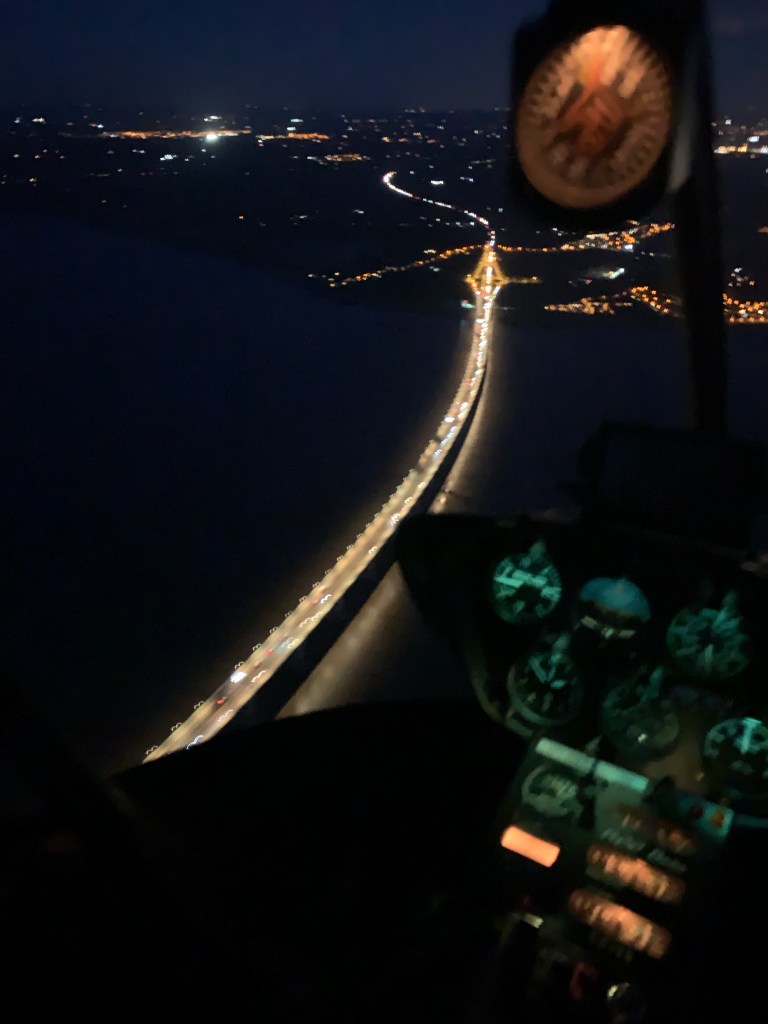
On the third sortie of the Night sessions, we had the most stunning of nightscapes, the sun was setting and leaving behind a deep blue sky. We headed over to the Forest of Dean and down towards the Severn bridges, crossing the estuary and following the motorway back up to Gloucester.
Night time Autorotations were next.. referring to my earlier point about everything just being calm; entering a constant attitude autorotation from 2500’, speed back to 40kias and descending slowly but surely into the deep pitch black abyss below. First emergency landing light on at 1500’ the second on at 1200’. The timing of the cushioning would have to be precise, aiming for an unknown field to the right hand side of the motorway.. Landing lights off, throttle on, needles joined and climbing away. Phew!
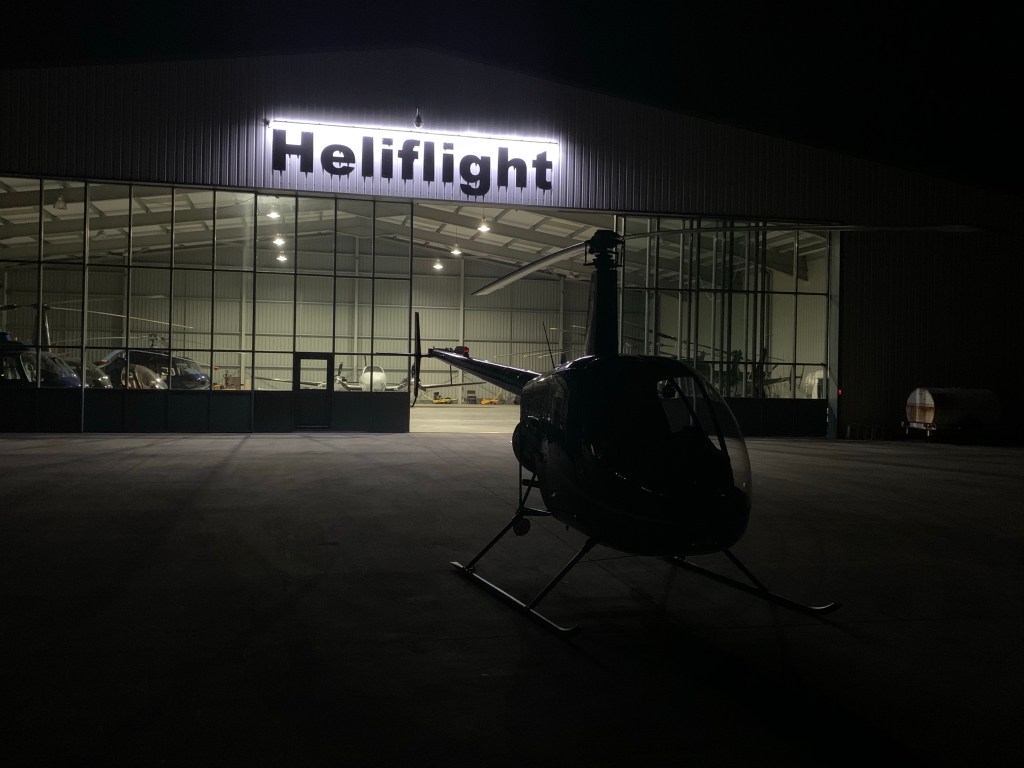
After 4 nights, spread over three weeks. We managed to complete 4 sorties. 1.6, 1.7, 1.2 and a 0.6 banking an extra 0.1 for good measure. In order to achieve a Night Rating, an additional 10 hours of instrument flying has to be completed. However, as these 10 hours make up a third of the Commercial course the night rating is incorporated within the CPL(H). 🌒🚁

 Hourbuilding Adventures