
Last Sunday I was standing in one of the expansive rooms of the Louvre museum on the banks of the Seine, in awe of the decorative grandeur of the vast ceiling and skylight, my eyes were scanning across the gold leaf and vibrant blue paints, when I saw the name L. Da. Vinci painted onto one of many plaques in the intricate artwork and it brought a smile to my face as I remembered that timeless quote:
“Once you have tasted flight, you will forever walk the earth with your eyes turned skyward, for there you have been, and there you will always long to return.”
No quote could be more apt, happily letting my mind wander to 4 days previous, climbing near vertically out of the Savoie heliport in Marnaz, Champagnoux, France in the most incredible machine I have ever flown. A machine for which I had the honour to taste flight in, back in 2019 and one for which I have since longed to fly again.
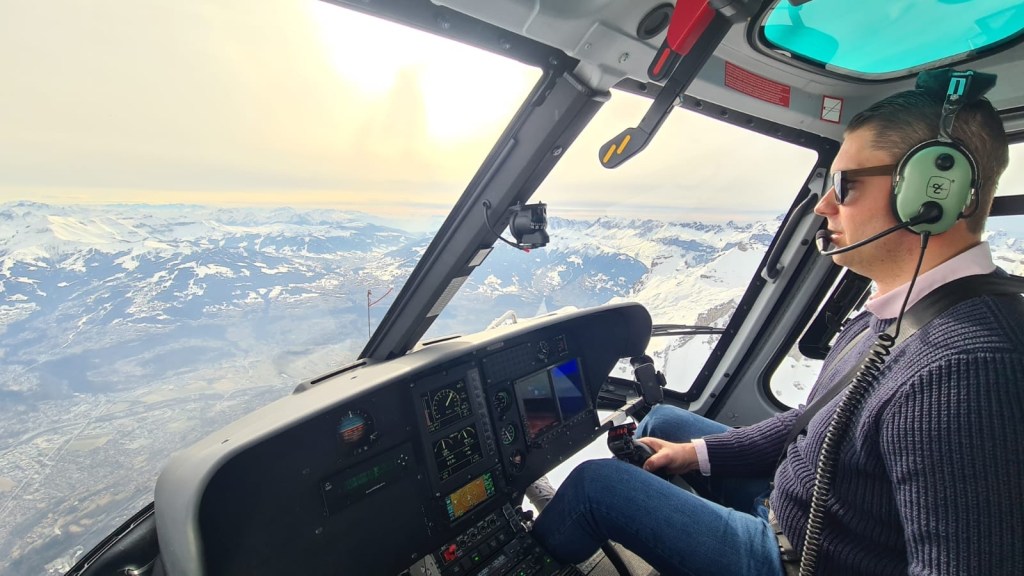
Rewind to being on the tarmac a few minutes previous, and I am sat in the captains seat of a graphite grey AS350 B3E, with less than 900 hours total time on the airframe and a pretty sharp paint scheme. Scanning the cockpit, it bears one resemblance to its distant cousin the AS350BA I rated on in december 2019, and that is just the shape of the instrument panel shroud. In front of me now sits a glass cockpit, 3 central console screens, and 2 directly in my view show the top down terrain map, and synthetic 3D AHI on the Left and Right screens respectively. I flick on the battery, and the central screens show the Turbine Outlet Temperature and Torque Gauges.
I think back to my experience of starting turbine helicopters, it was always quite ‘an involved… experience’ I think is the most fitting terminology, much more so than the turnkey starts of the R22 and R44. The Jetranger can be severely damaged, and the rear end of the turbine written off completely in under a minute if you have finger trouble on starting. The AS350BA is a little easier to start as you hold the starter button on the end of a lever and progressively maintain the forward movement to keep the Turbine Outlet temperature at ~600 deg until the turbine is self-stabilized. I was perplexed at the lack of this lever in the B3E, instead, one switch, overhead: ‘Eng Start’.

I think back now, and recall I was dubious. This was my first experience of Dual Full Automated Digital Engine Control (FADEC), and as a pilot I most certainly felt ‘out of the loop’ when bringing the machine to life. I moved the ‘Eng Start’ switch to ‘On’ and resided myself to monitor the digital engine gauges, as the magic computers did their work (in what was a very short amount of time) in stabilising the turbine. I deselected the Fuel Pump after engine start, and focussed on the two settings of the collective, the one in which the engine was started: ‘Idle’ and after a firm twist, I set the Astar into ‘Flight’ and the distinctive 3 bladed squirrel ‘chop’ symphony roared to life as the RRPM settled in the green at 100%.
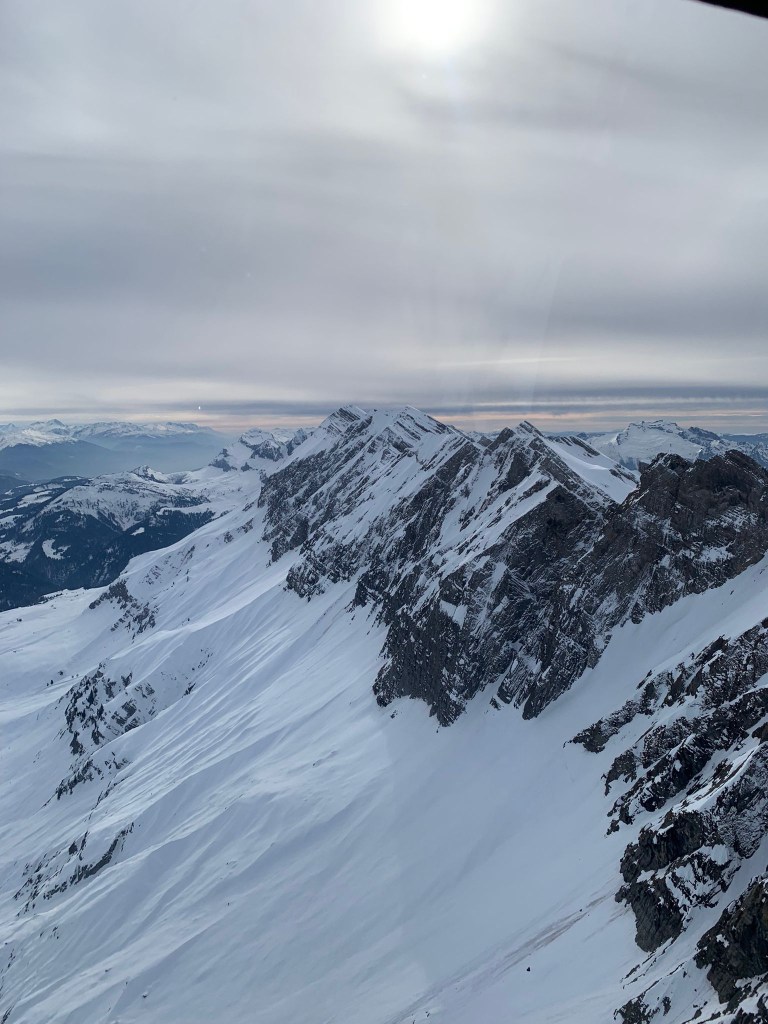
Back to climbing out of the heliport, upto 2500ft, at 50knts IAS, at max continuous torque of 90%, the real fun began, as the industrial area of Marnaz was soon out of sight behind the machine and the vista that soon filled the windshield was rolling snow covered mountains in every direction, with Geneva less than 40 minutes away, and the powerfully distinctive Mont Blanc so close it filled an entire quarter of the cockpit window. The exploration continued, via Megeve, towards the mountain ranges of Col D’Aravis.

I took the H125 onto a snow covered plateau, i’d landed in snow once before at Urchinwood Manor, outside of Bristol in an R22. At the time it felt like a big step, with snow like icing sugar covering the paddock, but now on approach to a 6500ft plateau with deep, untouched snow it paled in comparison. The machine settled into the white dust and it felt surreal to be perched on a mountain peacefully inside the cockpit, whilst the rotors beat the air into submission outside.
If you search for videos of the AS350 in the mountains, you will invariably come across some astounding ones of pilots perching nose in to a glacier or balancing one skid on a snow covered ledge before an incredible peel away down the mountain side on take off. I’m not one to miss an opportunity and you should always remember a golden rule in life: ‘don’t waste good’. So I came up into the hover, and peeled away over the side of the sheer face of the mountain, in a descending right turn into valley below, before pulling power to climb up and over the Aravis peaks to see the Confins Lake and the resort of La Clusaz below.
I could have stayed up for hours and the H125 would have let me, as every manoeuvre was effortless and flawless (on the part of the machine at least!), alas it was time to RTB at the heliport in Marnaz. One final treat was up the sleeve of Alexis who sat beside me as one of the instructors from Savoie Helicopters.
I once read a book by Helen Krasner, it was called ‘Learning to Fly Helicopters – a companion to the PPL(H)’. A section of the autorotation chapter has stuck with me, where she stated that as a student, your first autorotations are intimidating and scary, but eventually, you grow to love them and even want to practice them. Something I couldn’t fathom at the time. After flying different types, I realised she was right. So as I sailed over the last of the peaks in excess of 7000ft and the heliport was visible in the distance, when I heard Alexis say: “Do you want to do an Auto?” My response was a resounding yes!
Collective down, and a click of the collective into ‘Idle’. I opted for a zero speed, bringing the AStar back to little to no IAS and monitoring the RRPM. As I descended in the Auto configuration, I used the pedals to conduct a 360 spiral before re-engaging the collective into ‘flight’ and heading home with a very large grin across my face.
AS350B3E – 0.6h.

 Hourbuilding Adventures