
“I was looking for a place to set her down, as I was taking fire, I managed to land at Ballykelly. A surprised and angry engineer made his way out of the hangar, and as he started to open his mouth to shout, what I can only imagine were profanities, the turbine exploded behind me.”
“I asked him politely if I could use his phone to call the squadron, to which he obliged. The squadron seemed awfully excited to speak with me: ‘Robert, don’t fly that aircraft!’, ‘I can’t’ I explained, ‘Oh good!’ Came the retort.. to which I interjected ‘..the engine has exploded’. I was met with silence from the other end of the line.”
“It transpires, that the scout turbines suffered in the early days from the oil ‘soaping-up’ and the oil sample from this aircraft had been delayed in arriving at the laboratory for testing, by the time the results were confirmed that the aircraft was at risk.. I was already flying it!”
This was my first real life flying story about the Westland Scout, from Robert Kellie, the POLO Aviation Chief Pilot (and also the man responsible for the first police helicopters in the UK, but that’s a story for another day including a megaphone, an AS350, a perpetrator and thicket of thistles). As a sprog at the helicopter museum, I’d always admired the Wasp and the Scout but as with everything within the hangar, the old birds had long since retired from being in the air.
It was a few weeks later, when I was with Brian Rowsell, a reserved but witty ex-AAC pilot, we were walking past the Scout in the helicopter museum hangar and he stopped, cocked his head and said poignantly, “I’ve checked, and I have flown this one, it’s in my logbook”. My eyes went wide with admiration, at the time thinking it to be one of the coolest things ever.

Fast forward to what must be close to 13/14 years and i’m in Southam, between Coventry and Rugby on a truly beautiful Sunday March afternoon. I’m in my flight suit, and flying boots, as I round the corner of the farmhouse garden, to see a beautifully proud Westland Wasp at rest, cold and dark in its own paddock.

Being around helicopters is always a source of childish glee, but this was a different feeling. It’s one thing being around a vintage type that is a hangar queen, and quite another when around a vintage type, that you’re about to bring to life and fly. The feeling was unrivalled.
The Wasp up close, is a true machine of unassuming beauty. An open-uncovered free turbine on the aft deck, an almost cumbersome looking oleo strut suspension set-up, a slightly drooping 4 blade main rotor head, and a bubble nose. It’s also a lot bigger than I expected, especially when doing the walk-around check, and gazing way up at the twin blade tail-rotor.

Sat in the aircraft, it has a distinctive vintage smell, something that just can’t be found in a Robinson and I’m in awe of the panel. The key instruments are shown by a white line grouping them together. Captain Cowley runs through the start-up procedure, the turbine breathes its fire and the whole aircraft shakes and rattles as it runs up to speed, and we are ready to go.
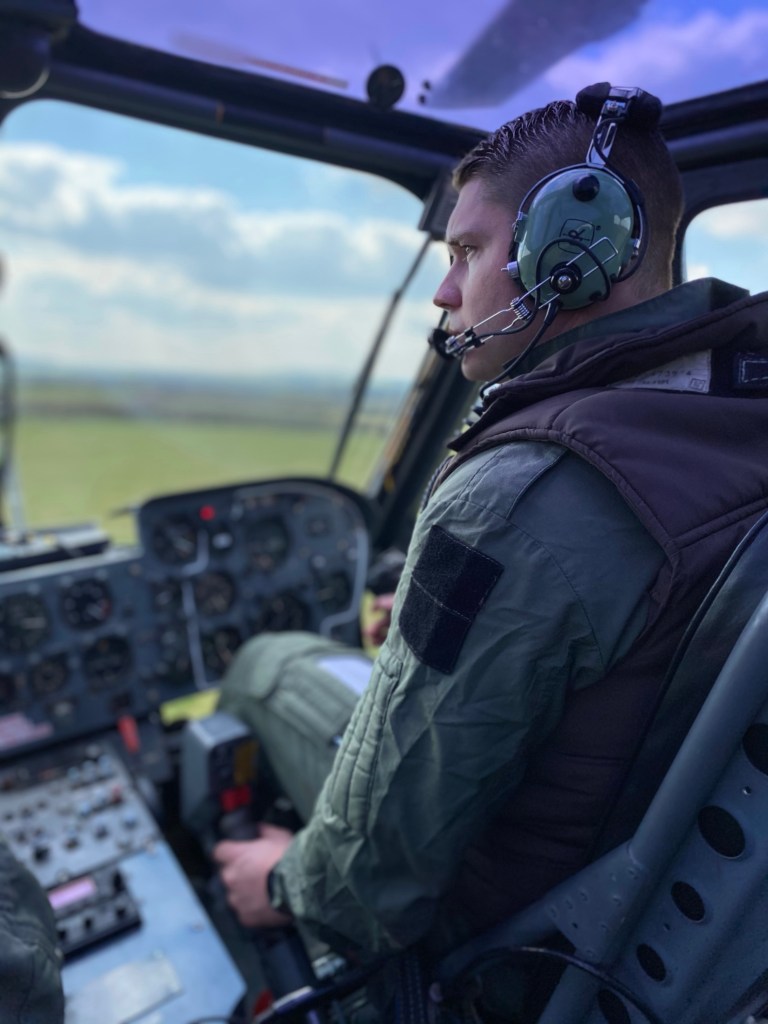
We hover-taxi, low-level out across the fields and we are en-route to Preston Capes Airfield. The first thing to note is the sensitivity of the Wasp in pitch axis, something I was briefed before departure in fact, and it is usually managed through use of the cyclic trim switch. I approached to the airfield, entered into my first hover in the wasp, completed a left 360 degree spot turn and a handful of landings, including the demonstration of the use of negative pitch, before flying a circuit.
On the second approach, I imagined how it must have felt, to be on approach to a Leander Class Frigate pitching and rolling at sea, with a 28ft by 21ft landing spot to settle the wasp on to. Something I continued to bear in mind throughout the rest of the day flying the incredible machine.
It was this thought, my passion for helicopters and rotary aviation and reminiscing on the stories I was told about the scout as a young boy at the helicopter museum, that made me decide to pursue the full type-rating on the Wasp and Scout later in the year.


 Hourbuilding Adventures